Paul Polman (b. 1956), former CEO of Unilever, redefined what leadership in business could mean. Where others chased quarterly profits, he looked to the next quarter-century. He believed that companies should serve society, not the other way around – that profit was the result of purpose, not its replacement. He thought in systems, seeing climate, poverty, and profit not as competing forces but as parts of the same equation of human progress.
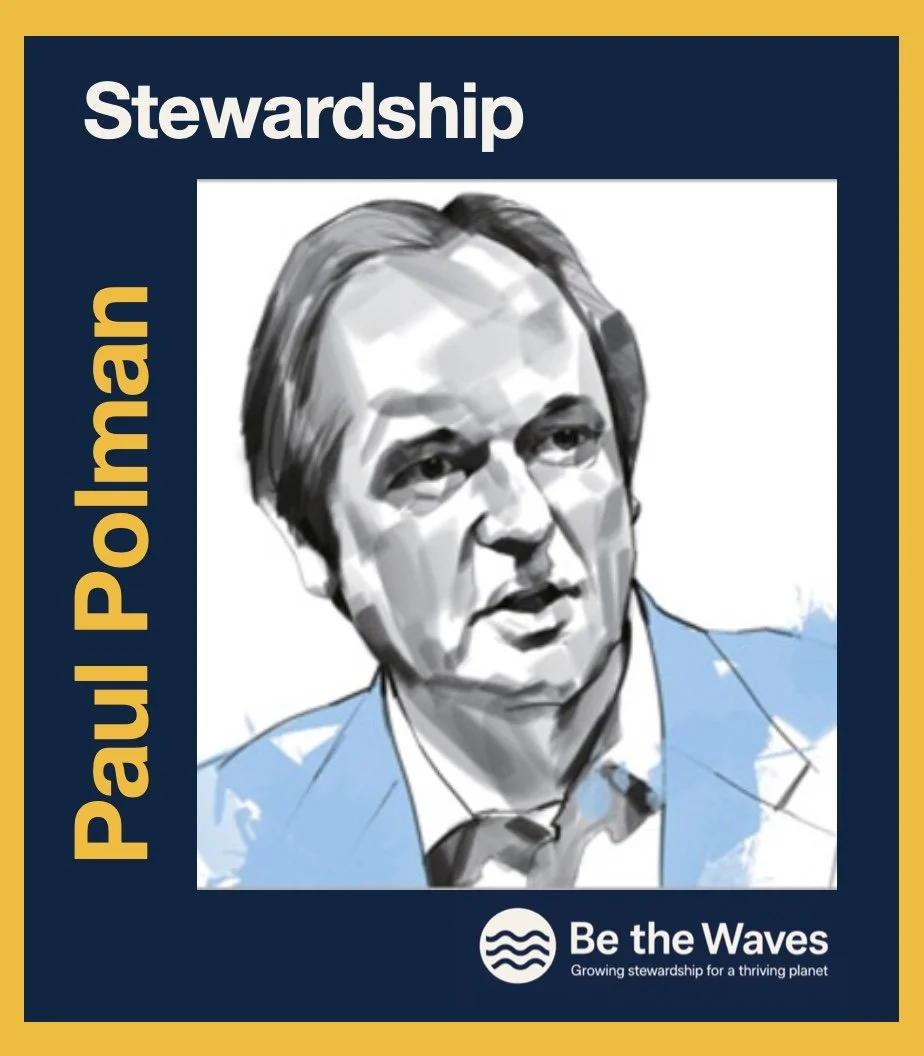
When he took the helm in 2009, the world was reeling from financial crisis. Trust in business was broken, and environmental warnings were being ignored. Polman responded not with image management, but with stewardship. He launched the Unilever Sustainable Living Plan, aiming to decouple growth from environmental impact and increase positive social outcomes for millions.
It was radical – a global corporation pledging to do well by doing good – and it worked. Unilever delivered consistent growth, cut waste and emissions, and became a model for sustainable capitalism. More than a business strategy, it was a statement: responsibility is not a cost; it’s the future.
Stewardship in Action
What made Paul Polman a steward rather than a conventional CEO? His leadership embodied the same constellation of attitudes, principles, skills, and behaviours that define stewardship across any system.
Attitudes & Beliefs
He believed business exists to serve people and planet, not extract from them.
He trusted that moral courage and market success could coexist.
He held hope that even complex systems can be reshaped from within.
Principles
Integrity meant aligning rhetoric with reality.
Responsibility extended across supply chains, climate, and community.
Continuity meant building a model that would endure beyond his tenure.
Skills
He united investors, NGOs, and governments around shared purpose.
He reframed ESG as core strategy, not compliance.
He practised systems thinking before it was fashionable – tracing how every product, policy, and partnership connects across economies, ecosystems, and lives.
Behaviours
He refused to issue quarterly earnings guidance, choosing long-term value over short-term noise.
He spoke plainly about moral duty in boardrooms that preferred metrics.
He built partnerships that advanced collective progress, not just market share.
This was stewardship expressed through commercial and moral courage – leadership with depth, conscience, and consequence.
A Living Example
Paul Polman reminds us that stewardship in business is not just about philanthropy – it’s about redesigning the engine itself. It’s leadership that links purpose to performance, conscience to capitalism.
He once said:
“We cannot choose between growth and sustainability – we must have both.”
His story leaves a question every boardroom must face:
Are we building companies that extract value, or those that extend it?
Over to You
As we continue to highlight the stewards among us, we’ll keep exploring how courage, care, and conscience can coexist in modern enterprise.
👉 Who in your world is redefining business as a force for good?
👉 Which organisations are truly stewarding their impact – economically, socially, and environmentally?
Let me know in the comments or send me a message. Together we can surface the examples that show business doesn’t just lead markets – it stewards futures.What do you think?
Stewardship isn’t perfection - it’s striving towards a systemic and collective approach which facilitates success; imagine that applied to climate, poverty or social inequality through business and enterprise.
Stefan
CEO, Be The Waves | Executive Coach | Father | Citizen
Don’t just lead. Steward. Create stewardship wherever you go. Be the Waves.