Part 6 - A 300-Year STEEPLE Vision A
At the end of part 5, we left the boardroom with a quiet revelation: stewardship is not a solo act. It is a collective, deliberate practice. Every voice in the C-suite carries a piece of the moral horizon. Together, they form the conscience of an organisation. But if we widen the lens beyond a single boardroom, beyond even the lifespan of an organisation, stewardship becomes something far greater - a force that shapes the trajectory of societies, ecosystems, and the human story itself.
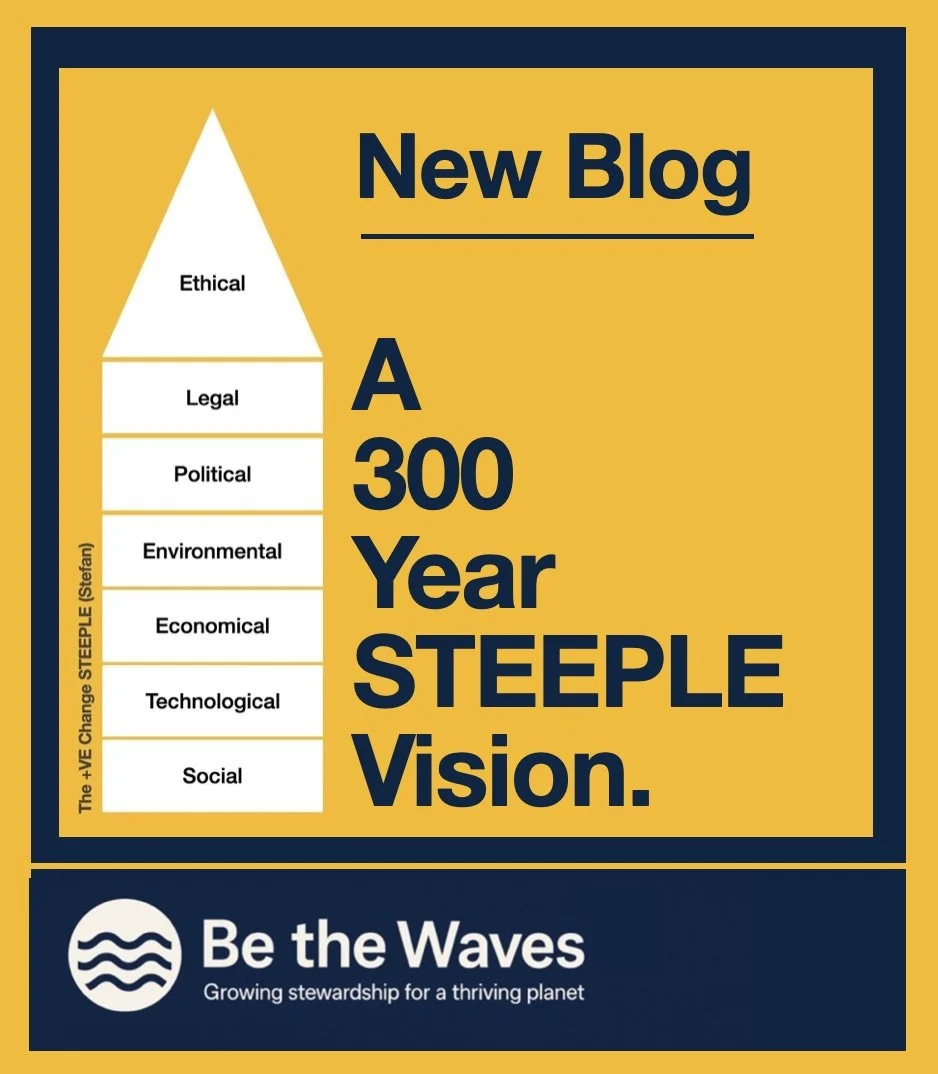
What if we extended this mindset not for a year, a decade, or a century, but for three centuries? What future would we dare to create if our choices today were measured against the lives and possibilities of generations yet unborn? To steward on this scale is to think in centuries, not quarters; in legacies, not metrics; in humanity, not expediency.
Why 300 Years Matters
We look three centuries ahead not because we will be here ourselves, but because the structures we create today - social, technological, economic, political, environmental - will endure long after we are gone. One hundred years is too short a lens. The rhythm of the world beats on far longer cycles than our own, and the consequences of inaction echo across centuries.
Some CO₂ we emit today will linger in the atmosphere for over a millennium.
Forests, wetlands, and soils can take centuries to recover from degradation.
Institutions, economies, and cultural systems persist far beyond our lifetimes.
Every decision we make - every delay, shortcut, or refusal to act - shapes the inheritance of those who come after us. It is a choice between abundance or scarcity, fairness or inequity, flourishing or decline. To steward responsibly, we must see both what is lost when we fail to act and what is gained when foresight guides our choices.
This edition asks a single, grounding question through the lens of STEEPLE:
If each domain of our shared world were shaped with a 300-year horizon, what future could we make possible?
S - Social
When we steward with a 300-year horizon: Communities are not just maintained - they thrive across generations. Schools, care networks, and public spaces become living legacies. Every person, young or old, is included, connected, and valued. Trust runs deep. Creativity flourishes. Social cohesion becomes a durable infrastructure, holding society together through decades of change.
If we don’t steward: Inequality calcifies. Communities fracture, isolation becomes inherited, and trust erodes. Cultural and social divides harden. Loneliness becomes a generational inheritance, and the innovation that relies on collaboration withers.
Make a Start Tomorrow
At Work: Host a cross-team conversation to shape culture as a legacy, not just a policy.
At Home: Discuss long-term wellbeing and shared values that ripple through your family for decades.
T - Technological
When we steward with a 300-year horizon: Technology becomes a partner in human flourishing. AI, digital systems, and infrastructure amplify potential rather than replace it. Knowledge is preserved, adapted, and democratised. Future generations inherit tools they trust, understand, and can shape responsibly. Innovation is guided by purpose and ethics, not just speed or profit.
If we don’t steward: Opaque algorithms and poorly designed systems entrench inequity. Societies become dependent on flawed technology, and decisions made today lock generations into unintended consequences that last centuries.
Make a Start Tomorrow
At Work: Deploy only tech that serves people, scales ethically, and strengthens long-term resilience.
At Home: Use technology consciously, setting boundaries that honour multi-generational impact.
E - Economic
When we steward with a 300-year horizon: Economies regenerate rather than extract. Wealth circulates across generations. Local and global communities thrive. Scarcity becomes a choice, not a condition. Societies are resilient, fair, and innovative for centuries. Every investment, transaction, and policy choice contributes to a living legacy of human and natural capital.
If we don’t steward: Extractive practices lock in scarcity. Inequality hardens, becoming the inherited reality of twenty future generations. Communities struggle to recover. Progress slows, innovation stalls, and cycles of poverty and privilege persist for centuries.
Make a Start Tomorrow
At Work: Redirect 1–2% of your budget to initiatives that regenerate human, social, or natural capital.
At Home: Spend with purpose, supporting fairness, sustainability, and long-term benefit.
E - Environmental
When we steward with a 300-year horizon: Forests, rivers, oceans, and soils regenerate. Cities breathe. Climate shocks are mitigated. Biodiversity thrives. Every action we take today seeds ecosystems that will sustain life for centuries. Human life and ecological vitality evolve together, in rhythm and balance.
If we don’t steward: Forests vanish. Oceans collapse. Soils erode. Extreme weather dominates daily life. Some ecosystems may take centuries to recover - or never recover at all. Generations inherit scarcity, fragility, and risk.
Make a Start Tomorrow
At Work: Replace one extractive habit with a regenerative alternative that safeguards ecosystems.
At Home: Adopt one eco-friendly habit—energy, waste, planting—to model stewardship for future generations.
P - Political
When we steward with a 300-year horizon: Governance becomes a relay, not a battlefield. Institutions sustain purpose across generations. Cross-party and civic compacts endure. Policy, dialogue, and civic participation weave a durable social contract. Future societies inherit stability, hope, and the ability to act collectively.
If we don’t steward: Polarisation seeds fragility for centuries. Trust in institutions collapses. Societies swing unpredictably between crisis and apathy. Future generations inherit broken frameworks and fragile civic life.
Make a Start Tomorrow
At Work: Lead or join a cross-department initiative that has enduring societal impact.
At Home: Engage in civic discussions, advocacy, or volunteering that strengthens community resilience over decades.
L - Legal
When we steward with a 300-year horizon: Laws protect ecosystems, future generations, and intergenerational justice. Legal frameworks anticipate harm before it unfolds. Contracts, policies, and regulations become tools to embed fairness and stability across centuries.
If we don’t steward: Exploitative legal loopholes and short-term thinking persist for generations. Harm becomes entrenched. Injustice becomes the inheritance of the distant future.
Make a Start Tomorrow
At Work: Review one policy or contract for fairness and intergenerational impact.
At Home: Apply fairness and accountability in household agreements and family decisions.
E - Ethical
When we steward with a 300-year horizon: Integrity, moral courage, and accountability become cultural inheritance. Truth shapes decisions. Principles outlast fleeting trends. Ethical decision-making is the foundation of societies that flourish across centuries.
If we don’t steward: Cynicism spreads. Short-term thinking becomes entrenched for generations. Trust erodes, innovation falters, and human flourishing suffers.
Make a Start Tomorrow
At Work: Decide with integrity, even at short-term cost, to model enduring values.
At Home: Act honestly and fairly, showing the next generation what lasting principles look like.
What This Demands of Us
As a Society
Create a shared 300-year national story.
Teach stewardship as a civic expectation.
Reward regeneration, fairness, and long-term thinking.
Protect spaces where truth, dialogue, and dissent can breathe.
As Organisations and Leaders
Ask in every meeting: “If this decision was still shaping lives in 300 years, would we still make it?”
Align metrics with ecological and human health - the fundamentals of long-term stability.
Make stewardship a cross-executive discipline.
Build leaders who create successors, not dependencies.
As Individuals
Extend your personal time horizon: imagine the 24th century inheriting your footprint.
Steward your immediate ecosystems - body, family, team, community.
Use your voice and veto when integrity is at risk.
Choose contribution: small acts compound over generations.
A Question for You…
If every choice you make this week became part of someone’s inheritance in 2325… what would change?
The Bridge to What Comes Next
If Part 5 showed who must steward, this vision has shown what we are stewarding - the interconnected systems that will define life three centuries from now. Social bonds, ecosystems, economies, laws, and ethical norms: each is fragile, enduring, and inherited.
Yet systems do not steward themselves. People do. Individuals, organisations, and societies must rise to the responsibility, cultivating foresight, courage, and regenerative action. To lead for centuries, we must learn to live with rhythm and renewal now.
In Part 7, we will turn from the horizon to the ground beneath our feet: exploring where stewardship happens - within our work, our homes, and our personal lives. Because before we can steward a world, we must first steward ourselves well enough to sustain the work.
Do not simply lead. Steward. Be the wave that keeps the ecosystem alive.
Stefan
CEO, Be The Waves | Executive Coach | Father | Citizen