Boardroom decisions today will echo for centuries.
Roughly 20–30% of CO₂ emitted today will remain in the atmosphere for hundreds to over a thousand years (Archer et al., 2009), locking in climate effects for generations. Forests, wetlands, and soils can take 200–300 years to recover from degradation, while human-made infrastructure and social systems persist across centuries (Chazdon, 2008; Steffen et al., 2015).
And next time we will explore a vision for 300 years from today, because in a world in which stewardship holds and has life is not 100 years, not even 200 - but 300 at the very least; the time it takes for some life to recover.
The systems we design now will shape lives long beyond our own. Carbon, biodiversity, and social infrastructure operate on timescales that far exceed quarterly reporting cycles.
We have already explored the core values that underpin thriving stewardship ecosystems - care, equity, courage, and contribution - which create the conditions for people, organisations, and environments to flourish together [link to Part 4]
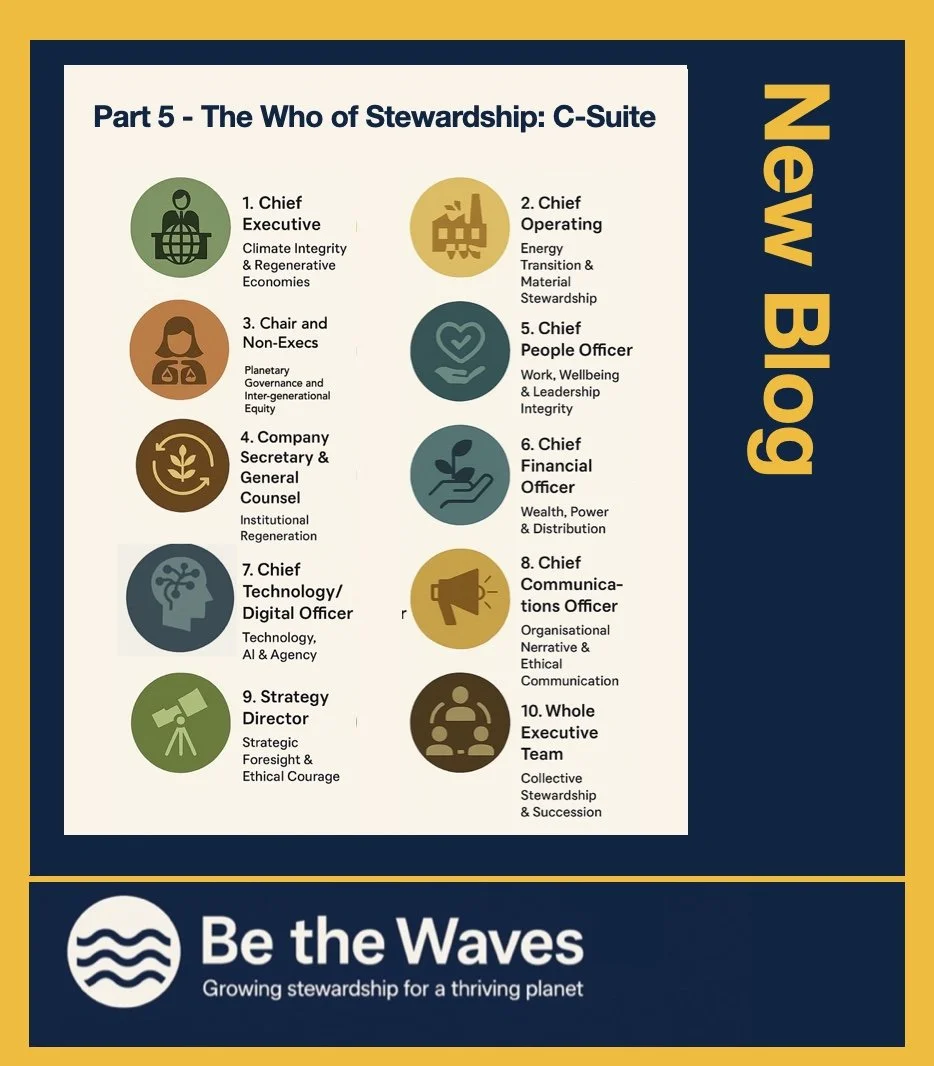
But no matter our values; no single leader can navigate this complexity alone. Stewardship is a team sport, where each member of the C-suite plays a distinct role, holding others to account, integrating knowledge across disciplines, and ensuring that strategy, operations, culture, finance, technology, and governance work in concert. Interdependency is not optional - it is the very mechanism through which resilience, ethical consistency, and long-term impact are achieved.
The generations of 2325 will inherit either thriving communities or depleted ecosystems. Whether they inherit abundance or scarcity, fairness or inequity, will depend on the courage, foresight, and collaboration demonstrated in today’s boardrooms. Stewardship is no longer quiet; it is both a strategic and moral imperative.
These are the ten challenges every stewarding board must face and the ‘lead’ who must steward it, if it hopes to lead not just profitably, but responsibly, for the next 300 years and generations beyond.
1. Climate Integrity and Regenerative Economies - The Chief Executive
The Chief Executive sets tone and direction. Their task is to move from sustainability slogans to regenerative intent - embedding planetary health into core strategy. Great CEO’s also consider the regenerative ability of an organisation itself and how that philosophy runs through everything an organisation does.
Climate science shows that carbon dioxide remains in the atmosphere for 300–1,000 years, meaning today’s emissions will still shape conditions in the 2300s. The Planetary Boundaries framework (Rockström et al., 2009) warns that humanity has already crossed several safe operating limits, including biosphere integrity and nitrogen use.
If a CEO wishes to leave a real legacy, they must act today, for tomorrow, not just tomorrows pocket. As David Attenborough reminds us, “What we do in the next fifty years will determine the fate of life on Earth for the next ten thousand.”
Stewardship means measuring success in continuity, not quarters.
CEO Question: Are our strategies shaping a thriving planet for centuries, not just this quarter?
2. Energy Transition and Material Stewardship - The Chief Operating Officer
Operations are where ideals meet reality. The COO holds the levers of production, supply chains, and logistics - where ethical choices become lived practice. A great COO will ensure that they leave a footprint for others to follow, not one for people to regret.
A circular economy, replacing the linear “take–make–waste” model, could unlock $4.5 trillion in global economic benefits by 2030 (Ellen MacArthur Foundation, 2015). Circular systems extend material life, reduce extraction, and cut emissions.
The COO role is to ensure that systems and functions operate in line with stewardship values; so that organisational life operates as an ecology mont a monopoly. As Rachel Carson wrote, “In nature, nothing exists alone.” Every operational decision ripples through ecological and social systems. Stewardship at scale means designing for reuse, repair, and regeneration - not waste.
COO Question: Are our operations leaving a legacy of regeneration rather than depletion?
3. Planetary Governance and Inter-generational Equity - The Chair and Non-Executives
Boards must now become guardians of time. The Chair’s stewardship duty is to balance today’s commercial mandate with tomorrow’s societal one. Non-Executives hold the moral scaffolding - ensuring decisions stand up to history, not just audit.
A great chair. does not direct - they ask stewardship questions ensuring that not only is an organisation resilient to profit and growth but that it creates an internal and external community which is resilient to the futire we are already creating. Complex systems science shows that resilience arises from diversity, feedback, and adaptive capacity (Folke et al., Science, 2010). Governance delivered on those principles - varied perspectives, transparent dialogue, and long-term accountability - protects organisations against both moral and material collapse.
Chair and Non Execs Question: Are we balancing today’s commercial pressures with the needs of future generations?
4. Institutional Regeneration - The Company Secretary
Trust is the quiet infrastructure of every organisation. These roles protect integrity as much as compliance - ensuring the letter of policy honours its spirit.
A great CS ensures that the board operates well - in line with law, best practice, and integrity. Public trust in institutions has fallen globally for over a decade (Edelman Trust Barometer, 2024). Rebuilding it demands transparency, ethical consistency, and visible fairness; working inconjucntion with the Chair is imperative. This is not ‘their will’ but ‘the will’ of whats right.
Behavioural science shows that people’s sense of justice within a system drives engagement far more strongly than reward. Stewardship here means designing governance that invites belief, not just obedience.
Company Secretary Question: Does our governance inspire trust, or merely enforce compliance?
5. Work, Wellbeing, and Leadership Integrity - Chief People Officer
The CPO is the conscience of the organisation. Their challenge is to create cultures that sustain rather than drain - where rhythm, rest, and respect underpin performance, and leadership integrity is visible at every level.
A great CPO impacts everything, because they safeguard humanity as a the conscience within the ecosystem. Neuroscience reveals that chronic stress shrinks the prefrontal cortex and insula, impairing empathy and ethical reasoning (Singer & Klimecki, 2016). Wellbeing and moral clarity are not perks but preconditions for cognitive and ethical performance. And wellbeing and moral clarity must live and breath in every leader within an organisation and be available to every person within an organisation. That is equity and inclusion. And includes the clarity of how, when and why AI will be used and how the ripples of an organisation effect the very climate humans, in its care, will face when they ‘leave the building’ every day. Now more than ever, digital implications and tech advancements must be balanced with people, place and planet.
As John Ruskin wrote, “There is no wealth but life.” Human sustainability and ethical leadership must now become strategic metrics - the energy that powers every other result.
CPO Question: Are we sustaining people, and the ethical standards that guide them, for the long term?
6. Wealth, Power, and Distribution - The Chief Financial Officer
Finance tells the truth about what an organisation values. The CFO’s stewardship is to redefine return - from extraction to contribution, from yield to shared value.
Great CFO’s are able to see and explain the impact of finance on future at a planetary level. Doughnut Economics (Raworth, 2017) reframes prosperity within social and ecological ceilings: growth that depletes is failure disguised as success. The transition from shareholder primacy to stakeholder stewardship is not ideology - it’s arithmetic. And depleting resources, including people and not focusing on the cost of extraction in all of its forms is a fool hardy financial strategy. We are sustaining for 300 years from now, not to show off to next years board.
A financial system that prices carbon, values community health, and rewards long-term investment is one that endures.
CFO Question: Are our financial decisions creating shared value rather than short-term gain?
7. Technology, AI, and Agency - The Chief Technology or Digital Officer
Technology amplifies intent. The CTO’s role is to ensure innovation remains human-centred, transparent, and fair.
Great CTO’s ensure that tech advances adopted consider people, place and planetary implications. AI, server banks and email subscription create Co2 in titanic quantities and a world in which machines replace people whilst not considering how humans find mastery, autonomy and purpose is a world not worth living in and people bring humanity - whuch cannot ruly be build into automata. Studies by MIT and Stanford show algorithmic bias can reproduce or magnify human prejudice, shaping hiring, credit, and policing outcomes at scale. Ethics must be coded in from the start - not patched in later. And the role of the CTO is to have that chat ahead of time; rather than ‘in time’.
As Marvin Minsky observed, “The question is not whether intelligent machines can have any emotions, but whether machines can be intelligent without any emotions.” True digital stewardship demands emotional as well as technical intelligence.
CTO Question: Does our technology amplify human and planetary potential, or limit it?
8. Organisational Narrative and Ethical Communication - Chief Communications Officer
The CCO stewards how the organisation tells its story - internally and externally - ensuring truth, clarity, and values are consistently communicated.
A great CCO doesn’t just report the narrative, they help write it. What do we want to be known for in the libraries of tomorrow, the blogs and AI recall of the next millenia and will we be known as heroes or villains. Research shows that transparent, consistent communication increases stakeholder trust and engagement by up to 40% (Edelman Trust Barometer, 2024). Ethical narratives embed moral clarity into decision-making and daily behaviour, turning abstract values into lived experience.
The highest act of stewardship in communication is not spin, but clarity - creating a shared understanding of where the organisation stands and why.
CCO Question: Are we telling the truth about who we are and what we stand for? And what is the truth we are working towards?
9. Strategic Foresight and Ethical Courage - Strategy Director
The Strategy Director ensures the organisation’s long-term decisions are both ambitious and ethical. Stewardship means being the voice that asks, “Are we creating the future we intend?” and holding leadership accountable to values as well as results.
A great Strategy Director facilitates the creation of a strategy that honours people, planet and place and doesn’t stop there. They ensure that organisational and departmental plans are synchronous and phased. This is architect and builder, foundation first, walls next, roof after. Each a foundation for the next. Each brick laid in order. Research on decision-making shows that teams with structured foresight and scenario planning are 30–50% more resilient to unforeseen shocks (Global Foresight Research, 2022). Ethical strategy integrates risk, opportunity, and moral responsibility - creating a culture where boldness and integrity coexist.
Integrity is caught, not taught; the Strategy Director stewards the frameworks and conversations that make ethical foresight possible, embedding it into every key decision.
CSD Question: Are our long-term plans bold, ethical, and resilient to uncertainty and how will we ensure that each piece of the plan is in the ‘right order’?
10. Collective Stewardship and Succession - The Whole Executive Team
Legacy isn’t left; it’s built together.
Succession planning becomes stewardship when every leader asks, “Am I leaving behind capability or dependency?”
A society grows great, says an old Greek proverb, when people plant trees whose shade they will never sit in.
In biological systems, resilience depends on succession - the renewal of life across generations. The same holds true in leadership. The highest act of leadership is to create more leaders.
And each member of the c-suite must ensure that those in the seat opposite them are being the best they can be; so that those who follow have role model they can aspire to be.
We re all different, and we all have different strengths, but make no mistake - we all know right from wrong - its about whether we are prepared to stand for it ask for it and now, at this time, with a longer time line of measurement.
For the success of today, is not the humanity of tomorrow.
Question for the whole: Are we building more leaders and ensuring resilience beyond our tenure and are we asking one another to lead in stewardship of what we are building?
Stewardship as a Team Sport
When stewardship is shared across the C-suite, it becomes the organisation’s conscience. Each role brings a different horizon - operational, human, ethical, planetary - but the work is collective.
No one person can steward the next three centuries. But together, leaders can create the conditions for life to thrive long after them.
That’s the work I do - helping those in these roles become the voice, the balance, and the courage in the room. Translating care into cadence. Conscience into collective action. And through board coaching, strategy days and through-org team coaching which asks why as well as what - we can truly deliver great things through good people.
The question isn’t whether your organisation will leave a legacy - it’s what kind.
Next time, I’ll explore the 300-Year STEEPLE Vision - stewardship might build towards and what it means for how we lead across society.
Thank you for reading. Your stewardship is expected.
Don’t just lead. Steward. Be the waves that keep the ecosystem alive.
Stefan
CEO, Be The Waves | Executive Coach | Father | Citizen