Part 6 - A 300-Year STEEPLE Vision.
At the end of the last piece, we left the boardroom with a realisation: stewardship is a team sport.
Each voice in the C-suite holds a part of the moral horizon; as we read in part 5. Together they form the conscience of an organisation.
This next step widens the frame. If stewardship within one boardroom shapes how an organisation behaves, stewardship across sectors and societies shapes how the world evolves.
So what happens when we extend that mindset across three centuries?
Why 300 Years Matters
We look 300 years ahead not because we expect to be here, but because the systems we design now will shape lives long beyond our own. Quite simply, 100 years isn’t enough.
Carbon, biodiversity, and social infrastructure operate on timescales that far exceed quarterly reporting cycles.
Around 20–30 % of CO₂ emitted today will remain in the atmosphere for hundreds to over a thousand years (Archer et al., 2009).
Forests, wetlands, and soils can take 200–300 years to recover from degradation (Chazdon, 2008).
The structures of our economies and institutions persist across centuries (Steffen et al., 2015).
When we act, delay, or look away from the implication of past and present on future - we are writing the conditions that the generations of 2325 will inherit - abundance or scarcity, fairness or inequity.
In order to hold the responsibility of stewardship effectively, we need to see what we are letting go of when we choose not to steward and what we gain when we do.
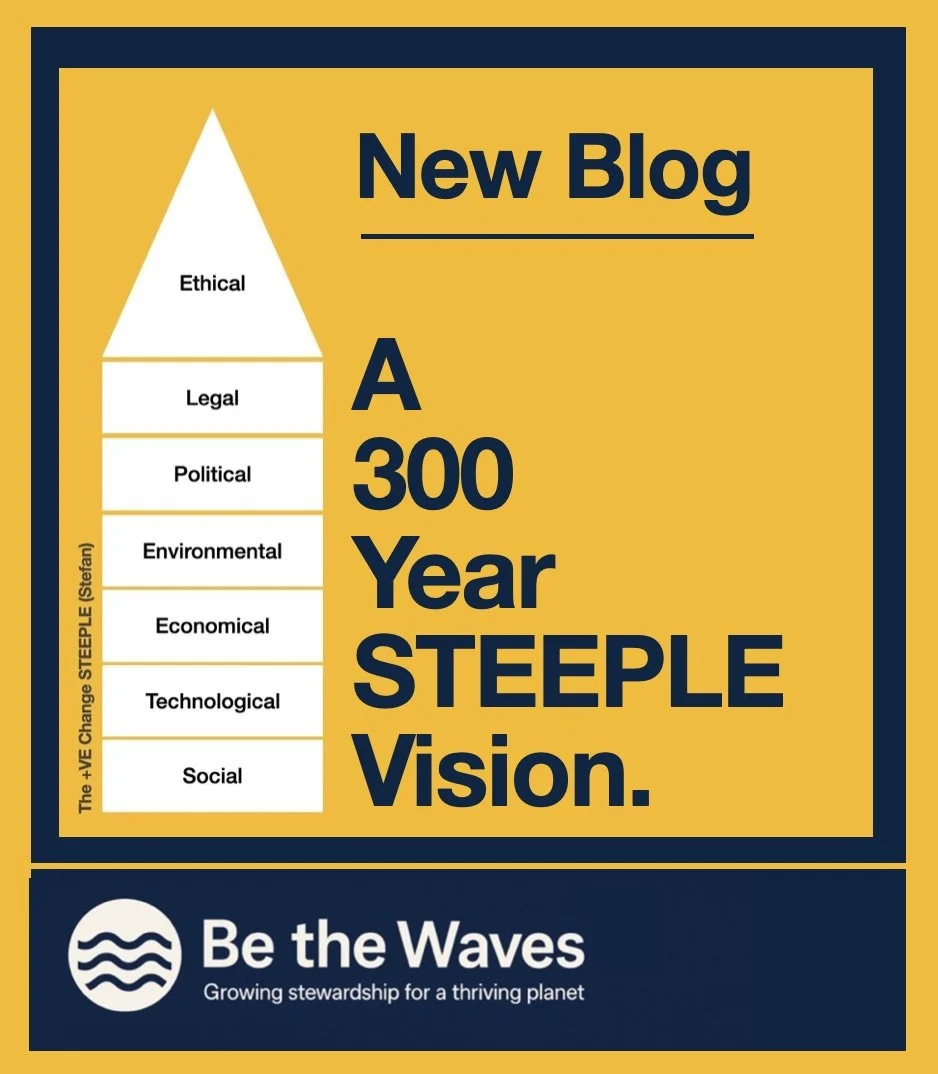
In this edition we feel it’s important to look wider than organisational constraints and instead, look through the STEEPLE lens to ask a single, grounding question:
If each of these domains were shaped with a 300-year horizon, what future could we make possible?
S - Social
When we steward with a 300 year horizon: Communities flourish for centuries. Schools, care networks, and public spaces are vibrant. People of all ages and backgrounds feel included, connected, and valued. Trust runs deep, creativity thrives, and cohesion becomes the backbone of society.
If we don’t steward: Inequality calcifies. Generations grow up isolated, fractured communities weaken, and trust erodes. Cultural and social divides harden, loneliness becomes hereditary, and societies struggle to function or innovate.
Make a Start Tomorrow
At Work: Host a cross-team conversation to build a culture that lasts generations.
At Home: Talk with your family about long-term wellbeing and shared values that ripple forward.
T - Technological
When we steward with a 300 year horizon: AI, digital systems, and infrastructure amplify human potential, making work, learning, and civic life richer and more inclusive. Technology evolves safely and responsibly, leaving future generations with trusted tools they can adapt.
If we don’t steward: Opaque algorithms and misaligned systems entrench inequity. People become dependent on flawed or unsafe tech. Decisions made today can lock society into centuries of unintended consequences.
Make a Start Tomorrow
At Work: Deploy only tech that serves people, is responsibly overseen, and scales positively for decades.
At Home: Use technology responsibly, with boundaries, considering its multi-generational impact.
E - Economic
When we steward with a 300 year horizon: Economies regenerate human and natural capital. Value circulates across generations, local and global communities thrive, and scarcity becomes avoidable. Societies are resilient, fair, and innovative for centuries.
If we don’t steward: Extractive practices lock future societies into scarcity. Inequality hardens and becomes the inherited reality of twenty future generations. Communities struggle to recover, and progress slows for centuries.
Make a Start Tomorrow
At Work: Redirect 1–2% of budget to initiatives that regenerate human, social, or natural capital.
At Home: Spend to support fairness, sustainability, and lasting benefit for your household and community.
E - Environmental
When we steward with a 300 year horizon: Forests, oceans, soils, and biodiversity regenerate. Cities breathe. Rivers run clean. Climate shocks are mitigated. Life remains vibrant and sustainable for centuries.
If we don’t steward: Forests vanish, oceans die, soils erode. Extreme weather and scarcity dominate daily life. Once-stable regions become uninhabitable, and some ecological damage takes centuries to reverse.
Make a Start Tomorrow
At Work: Replace one extractive habit with a regenerative alternative that safeguards ecosystems.
At Home: Adopt one eco-friendly habit (energy, waste, or planting) to model stewardship for generations.
P - Political
When we steward with a 300 year horizon: Institutions sustain purpose across generations. Governance becomes a relay, not a battleground. Cross-party and civic compacts endure, creating stability and hope for future societies.
If we don’t steward: Polarisation seeds centuries of fragility. Democratic trust erodes. Societies swing unpredictably between crises and apathy, leaving future generations with broken institutions.
Make a Start Tomorrow
At Work: Lead or join a cross-department initiative with long-term societal impact.
At Home: Engage in civic discussions, advocacy, or volunteering that strengthens community resilience over decades.
L - Legal
When we steward with a 300 year horizon: Laws protect ecosystems, future generations, and intergenerational justice. Legal frameworks prevent harm before it unfolds across centuries.
If we don’t steward: Exploitative or short-term legal structures persist for centuries. Loopholes allow harm to become entrenched, creating legacies of injustice for generations.
Make a Start Tomorrow
At Work: Review one policy or contract for fairness and intergenerational impact.
At Home: Apply fairness and accountability in household agreements and family decisions.
E - Ethical
When we steward with a 300 year horizon: Moral literacy, courage, and integrity become the inherited norms of culture. Truth and accountability shape decision-making across generations.
If we don’t steward: Cynicism spreads. Integrity erodes. Short-term thinking hardens into centuries-long moral climates that undermine trust, innovation, and human flourishing.
Make a Start Tomorrow
At Work: Decide with integrity, even at short-term cost, to model enduring values.
At Home: Act honestly and fairly, showing the next generation what lasting principles look like.
What This Demands of Us
As a Society
Create a shared 300-year national story.
Teach stewardship as a civic expectation.
Reward regeneration, fairness, and long-termism.
Protect spaces where truth, dialogue, and dissent can breathe.
As Organisations and Leaders
Ask in every meeting: “If this decision was still shaping lives in 300 years, would we still make it?”
Align metrics with ecological and human health - the fundamentals of long-term stability.
Make stewardship a cross-executive discipline.
Build leaders who create successors, not dependencies.
As Individuals
Extend your personal time horizon: imagine the 24th century inheriting your footprint.
Steward your immediate ecosystems - body, family, team, community.
Use your voice and veto when integrity is at risk.
Choose contribution: small acts compound over generations.
A Question for You…
If every choice you make this week became part of someone’s inheritance in 2325… what would change?
The Bridge to What Comes Next
If Part 5 showed who must steward, this vision has explored what they’re stewarding - the interconnected systems that will define life three centuries from now.
But systems don’t steward themselves.
People do.
To lead for centuries, we must learn to live with rhythm and renewal now.
In Part 7, we’ll turn from the horizon to the ground beneath our feet - exploring the where of stewardship: How we hold it in our work, our homes, and our personal lives.
Because before we can steward a world, we have to steward ourselves well enough to stay in the work.
Don’t just lead. Steward. Be the waves that keep the ecosystem alive.
Stefan
CEO, Be The Waves | Executive Coach | Father | Citizen