Ken Robinson – A Steward of Human Potential
Sir Ken Robinson (1950–2020), educator, author, and global advocate for creativity, dedicated his life to one simple but radical idea – that human potential is something to be cultivated, not standardised.
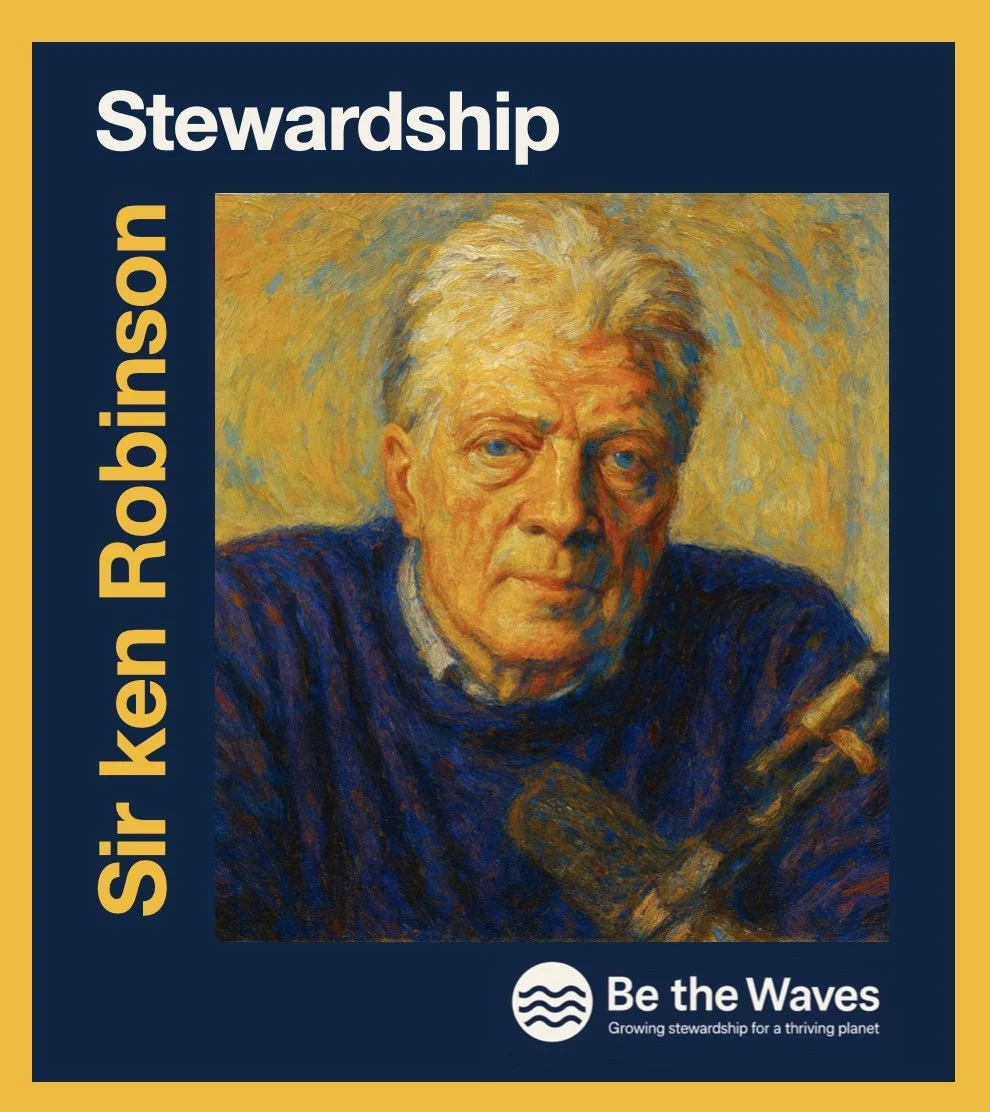
At a time when education systems have increasingly shown obsession with measurement, compliance, and uniform outcomes, Robinson stood up for something quieter and deeper. He argued that people flourish when their talents are recognised, their curiosity is protected, and their differences are treated as strengths rather than problems to be fixed.
His message reached millions through talks, books, and conversations that cut through jargon and hierarchy. He didn’t speak down to people or hide behind theory. He spoke plainly, humanly, and with care – reminding us that systems designed without regard for the human spirit eventually fail the very people they are meant to serve.
This was stewardship – not of institutions, but of possibility.
Stewardship in Action
What made Ken Robinson a steward rather than simply a critic of education?
His work embodied the same constellation of attitudes, principles, skills, and behaviours that define stewardship across any system.
Attitudes & Beliefs
He believed every person has unique gifts that deserve recognition.
He trusted that creativity is not rare – it’s universal, but often suppressed.
He held hope that systems could change without losing rigour or purpose.
Principles
Dignity mattered more than ranking.
Diversity was a source of strength, not inefficiency.
Continuity meant designing systems that could nurture generations, not just produce results.
Skills
He translated complex ideas into language people could feel and remember.
He bridged education, culture, business, and policy without losing clarity.
He reframed failure as feedback, not judgement.
Behaviours
He consistently challenged dominant narratives without attacking people.
He amplified the voices of teachers, parents, and learners.
He stayed focused on the human cost of systems that forget why they exist.
This was stewardship expressed through care and courage – holding space for growth while insisting on change.
Quotes
“We have to go from what is essentially an industrial model of education, a manufacturing model, which is based on linearity and conformity and batching people. We have to move to a model that is based more on principles of agriculture. We have to recognise that human flourishing is not a mechanical process; it's an organic process. And you cannot predict the outcome of human development. All you can do, like a farmer, is create the conditions under which they will begin to flourish”
“Our task is to educate their (our students) whole being so they can face the future. We may not see the future, but they will and our job is to help them make something of it”.
“One of the essential problems for education is that most countries subject their schools to the fast-food model of quality assurance when they should be adopting the Michelin model instead. The future for education is not in standardizing but in customising; not in promoting groupthink and “deindividuation” but in cultivating the real depth and dynamism of human abilities of every sort”.
A Living Example
Ken Robinson reminded us that stewardship is not about lowering standards – it’s about widening the definition of success.
He showed that when we design systems around how people actually grow, learn, and create, we unlock energy rather than compliance, contribution rather than conformity.
Ahead of his time, and the onslaught of Ai - enabling more to be, perhaps, more precise than ever - but perhaps less human; he asked us to be creative, in all its forms and to recognise and nurture the brilliance of the human and its capacity to grow and heal in all forms
His work leaves us with a question that reaches far beyond education and asks us: Are the systems we steward helping people become more fully themselves – or slowly convincing them that they are not enough?
Over to You
This piece can only ever be an introduction and I'd recommend we all read and absorb more of his words. As we continue to surface stewards across different fields, we turn next to those who quietly protect human potential in their own contexts.
👉 Who do you see stewarding talent, creativity, or possibility in your organisation or community?
👉 Where are people creating conditions for others to grow, rather than forcing them to fit?
Share your examples or message Be The Waves – together, we can highlight leadership that doesn’t just manage outcomes, but lights the way for others.
Stefan
CEO, Be The Waves | Executive Coach | Father | Citizen
Don’t just lead. Steward. Create stewardship wherever you go. Be the Waves.